Carbon reporting has reached the print room. In Quocirca's Nov 2025 survey of 560 IT decision makers, 77% of organisations had a company-wide sustainability practice, up from 68% in 2024. Yet the same buyers ranked a lack of data on the environmental impact of printers joint second among their concerns. If your office knows its print bill but not what its printing emits, this guide closes that gap.
The carbon footprint of printing is the greenhouse gas released to make the paper, power the printers, and make and dispose of the toner and the waste, counted in kilograms of carbon dioxide equivalent (CO2e). By our sums, paper is the largest part by a wide margin, and it is also the part an office can cut fastest.
This guide shows how to measure each part with the UK government's own conversion factors, which changes cut it most, and where offsetting fits. We hold ISO 14001 for environmental management, and every figure below shows its source and working.
Key takeaways
- By our sums, paper outweighs printer electricity many times over, so the sheets you print matter most.
- An A4 sheet carries about 5 g to 7 g of CO2e before it is printed, by the 2026 UK government factors.
- Count pages from meter readings or print reports, then apply the government factors to sheets, kWh and waste.
- Mono and double-sided defaults and secure release cut sheets without anyone having to remember.
- Tree planting and offsets can follow real cuts, but on their own they do not make printing carbon neutral.
What makes up a print carbon footprint?
The carbon footprint of printing comes from four places: making the paper, powering the printers, making and delivering the toner and the devices, and dealing with the waste. In the GHG Protocol's terms, printer electricity is Scope 2, while paper and toner count as Scope 3 purchased goods and waste paper as Scope 3 waste.
The split matters because most companies already count part of it: printer electricity sits inside the energy figure they report today. Paper, toner and waste sit in Scope 3, the supply-chain emissions that UK reporting rules do not require.
So paper is usually the missing piece. A print audit gives you the numbers to close it: every device, the pages it prints and the consumables it uses.
What is the carbon footprint of printing paper?
An A4 sheet of standard 80 gsm office paper carries about 5 g to 7 g of CO2e before it is printed. By our calculation from the 2026 UK government factors, virgin paper comes to about 6.7 g a sheet and recycled paper about 5.2 g. Sending the sheet to landfill afterwards adds about 5.8 g more.
The sum is simple to check. An A4 sheet of 80 gsm paper weighs about 5 g, so about 200 sheets make a kilogram. The government's 2026 conversion factors, published by the Department for Energy Security and Net Zero in Jun 2026, put virgin paper at 1,343.6 kg of CO2e a tonne and recycled paper at 1,048.6 kg. On those figures, a 500-sheet ream of virgin paper carries about 3.4 kg.
What happens afterwards matters too. Paper sent to landfill counts at 1,164.5 kg of CO2e a tonne, mostly from the methane it gives off as it breaks down. Paper sent for recycling counts at 4.7 kg a tonne, a figure that covers only the trip to the recycling plant, but the gap still shows how far the recycling bin beats the general waste bin.
Our environmental page has a calculator that turns monthly page counts into standard trees, at PrintReleaf's rate of one tree for every 8,333 pages.
How to measure your print carbon footprint in five steps
Once you have a year of data, the sums are quick. Use your reporting year, and note each number's source so the sum can be repeated.
Most of the data already exists. Managed devices send meter readings to the supplier through automated print monitoring. Print management software such as PaperCut MF also reports pages by device, user, department and environmental impact.
- Count the sheets. Take a year of page counts from meter readings or print reports. Count sheets, not pages: a double-sided sheet is two pages but one sheet of paper.
- Turn sheets into tonnes. At 80 gsm, about 200 A4 sheets weigh a kilogram, so 200,000 sheets is about a tonne.
- Apply the paper factor. Multiply the tonnes by 1,343.6 for virgin paper or 1,048.6 for recycled paper to get kilograms of CO2e.
- Add the electricity. Take each device's typical electricity consumption (TEC), the kWh it uses in a standard week, then multiply by 52 and by 0.131 kg of CO2e a kWh. Our heat-free and laser comparison walks through the same TEC sum.
- Add the waste and note the gaps. Apply the landfill or recycling factor to the paper you throw away, then record what you left out, such as toner, which has no government factor.
Take the 20,000 pages a month our environmental calculator uses as its example. Printed single-sided, that is 240,000 sheets a year, or about 1.2 tonnes of paper. On virgin paper it comes to about 1.6 tonnes of CO2e, and on recycled paper about 1.3 tonnes.
Electricity is far smaller. Every 1 kWh of weekly TEC adds about 6.8 kg of CO2e a year at the 2026 factor, so a device with a TEC of 3 kWh a week adds about 20 kg. These are our sums from published factors, not a measured result.
| Source | What to count | 2026 factor | Per A4 sheet |
|---|---|---|---|
| Virgin paper | Sheets bought | 1,343.6 kg a tonne | 6.7 g |
| Recycled paper | Sheets bought | 1,048.6 kg a tonne | 5.2 g |
| Paper to landfill | Sheets binned | 1,164.5 kg a tonne | 5.8 g |
| Paper recycled | Sheets recycled | 4.7 kg a tonne | Under 0.1 g |
| Printer power | kWh a year | 0.131 kg a kWh | Varies |
How can you cut what your printers emit?
Print fewer sheets first, because paper is the largest share and every sheet saved also comes off the paper bill. Make mono and double-sided the default, hold jobs until people release them, retire devices nobody needs and let the rest sleep, then buy recycled paper and recycle what you throw away. Offsetting comes last, on whatever remains.
Print fewer sheets
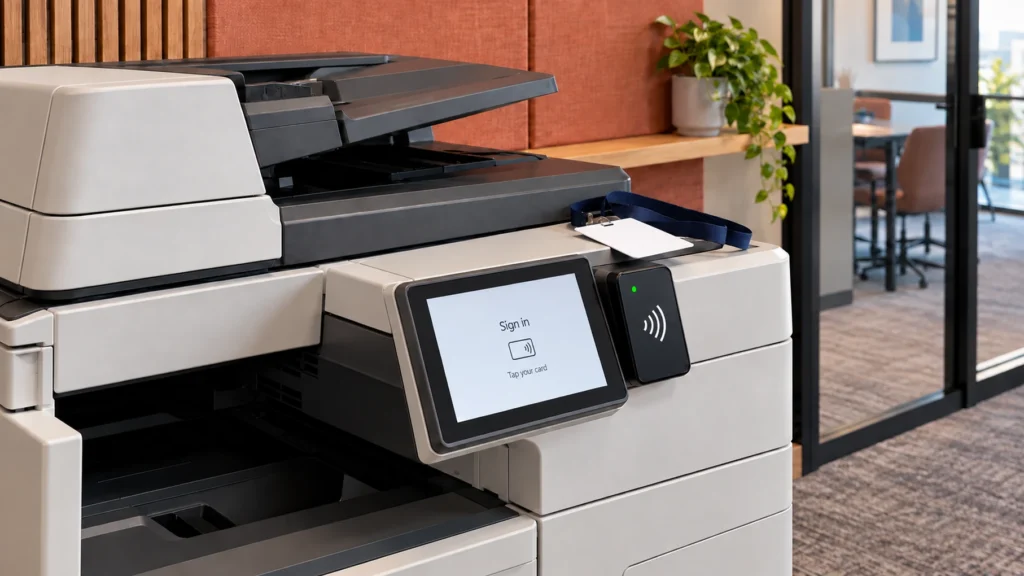
Changing the default settings saves paper without asking anyone to change their habits. When print management makes mono and double-sided the default, every job follows the rule, and secure release means jobs nobody collects are never printed. In the case study on that page, secure release cut waste by around 15% and print volumes fell 14% within 12 months. In the same Quocirca survey, the share of organisations using rules-based printing rose from 26% to 40%.
Use less power
Electricity is the smaller share, so it comes second. Every device you retire stops drawing power, and the rest should sleep soon after the last job. When a lease ends, look at the device type too: Epson reports that its heat-free printers use up to 83% less energy than a comparable laser, because nothing is heated to fix the ink.
Buy and bin paper better
Recycled paper lowers the factor from 1,343.6 to 1,048.6 kg a tonne, about a fifth less. A recycling bin beside every printer matters more: a sheet sent to landfill adds about 5.8 g, more than a recycled sheet cost to make.
Recycle toner
Toner has no government factor, but cartridges should never go in the general waste. Insight collects used toner and packaging rather than leaving them for the bin, and the same survey found 52% of organisations use ink and toner recycling programmes.
Source: Insight Systems sustainability and print management pages, Oct 2026. PrintReleaf counts one standard tree for every 8,333 standard pages.
Is carbon neutral printing worth paying for?
Carbon neutral printing usually means paying for offsets or tree planting to balance the pages you print. It is worth doing once you have cut what you can, but it does not remove any emissions, and PrintReleaf itself says its reforestation does not support a carbon neutral claim on its own.
According to PrintReleaf's guidance on claims, its reforestation projects do not generate carbon offsets, so customers should describe their paper as tree neutral rather than carbon neutral, and count standard trees. We report our customers' paper the same way.
That wording matters. The CMA's Green Claims Code says environmental claims must be substantiated and that a business relying on offsetting should name the scheme it uses. It also applies, to a more limited extent, when one business markets to another.
Our earlier piece on how PrintReleaf works sets out the order we recommend: cut unnecessary printing, change how you print, then offset what remains.
Where should your office start?
Start with a year of page counts, because every other number depends on them. Then set mono and double-sided defaults, put a recycling bin beside each printer and check that idle devices sleep. Decide on carbon neutral printing only once those are in place.
If you do not have the counts to hand, our free print audit collects them for every device, and the next-generation version also reports the energy savings, CO2 reductions and trees saved that a different setup could achieve.
Frequently asked questions
An A4 sheet of 80 gsm paper carries about 5 g to 7 g of CO2e before printing: about 6.7 g for virgin paper and 5.2 g for recycled, by our calculation from the 2026 UK government factors. If the sheet then goes to landfill rather than recycling, add about 5.8 g more.
The biggest cuts come from printing fewer sheets, through print management software that makes double-sided and mono the default and holds jobs until people release them. After that, fewer devices with short sleep timers, low-energy devices such as Epson's heat-free range, recycled paper and recycling for paper and toner all help.
Not as a separate figure. Under Streamlined Energy and Carbon Reporting, quoted companies and large unquoted companies and LLPs report their energy use and the emissions from it, so printer electricity already sits inside that total. Paper, toner and waste are Scope 3 emissions, which the rules do not require, so including them is your choice.
Not quite, but it comes close for the paper. Printing a multi-page document double-sided halves the sheets it uses, so the carbon from paper, the largest share, falls by up to half. Single-page jobs see no change, and electricity is a small share either way. A double-sided default is the simplest way to get the saving.
Our free print audit counts every device and the pages each one prints. The next-generation audit adds the energy savings, CO2 reductions and trees saved that a different setup could achieve.
Measure Your Print Footprint