Ask most suppliers about the benefits of managed print services and you get the same list: lower costs, better security, less hassle. What you rarely get is a number with a source, which is what a finance lead or a board wants before signing a print contract.
Managed print services (MPS) put your printers and copiers, toner, servicing and print software under one provider on one agreement, with the fleet monitored remotely. The benefits come from that arrangement: one bill instead of several, faults caught before anyone calls, and rules that stop waste at the device.
This guide gives each benefit with the evidence behind it. Some figures are our own, published on our print management page and labelled as ours. The rest come from independent studies, with the source, date and sample given, all checked in Sep 2026.
Key takeaways
- Insight's published figure is up to 40% off print-related costs. An audit gives your real number.
- In Quocirca's 2026 study, 67% of organisations had a print-related data loss in the past year.
- Remote monitoring lets us fix about a quarter of faults without an engineer visit.
- Only 42% of organisations are very satisfied with their MPS provider, so the provider matters.
- Consolidating devices and defaulting to mono and double-sided do much of the saving.
What are the benefits of managed print services?
The main benefits are lower and more predictable print costs, fewer print-related security incidents, less downtime, less waste and less admin. They come from putting every device, supply and support call on one agreement, then using remote monitoring and print rules to control what the fleet does.
Each benefit can be measured, and each can fail to appear if nobody reviews how the fleet is used. Each section below gives a figure and what it takes to see it.
Our own figures come from the pages we publish and one anonymised case study. Independent figures come mainly from Quocirca, a UK research firm whose annual studies survey around 400 IT decision makers in the UK, France, Germany and the US. Our guide to managed print across London, Essex and Kent covers who does the work day to day.
How much can managed print services save?
Insight's published figure is up to 40% off print-related costs, for a print management setup that is configured properly and used day to day. Treat that as a ceiling rather than a promise: the saving depends on how much waste your current fleet carries, which is what a print audit measures before anyone quotes.
Cost is the easiest of the benefits of managed print services to prove, and a few controls do the work. Consolidating scattered devices means fewer machines to lease, power and service. Mono and double-sided defaults matter because mono costs around a tenth as much as colour per page. Secure release stops forgotten prints, and automatic toner ends the shelf of cartridges bought early.
Our published case study shows how they add up. A non-profit came to us with rising print costs, frequent downtime and no view of usage by department. We consolidated its devices into one managed fleet, added secure release and switched on automatic toner and remote monitoring. Secure release cut waste by around 15%, print volumes fell 14% within 12 months, and the organisation now saves £55,000 a year in print-related costs.
How much of that you would see depends on your starting point, which a free print audit measures device by device. Our guide to what a print audit shows explains the report.
Source: Insight Systems case study, a non-profit organisation.
Does managed print make printing more secure?
Yes, if the service includes print security rather than only devices. Quocirca's 2026 print security study found 67% of organisations had at least one print-related data loss in the past year, up from 56% in 2025, and 43% had more than one. Organisations with fuller print security reported fewer losses.
The study puts the average cost of a print-related breach at just over £1 million, up from £820,000 a year earlier. Organisations Quocirca ranks as leaders, with print security tools and policies in place, reported data losses at 56%, against 73% for the laggards.
Print is one part of a wider risk. The government's Cyber Security Breaches Survey 2025/2026 found 43% of UK businesses identified a cyber breach or attack in the past year. Under UK GDPR, a personal data breach includes the accidental disclosure of personal data, so a payslip left in an output tray can count as one.
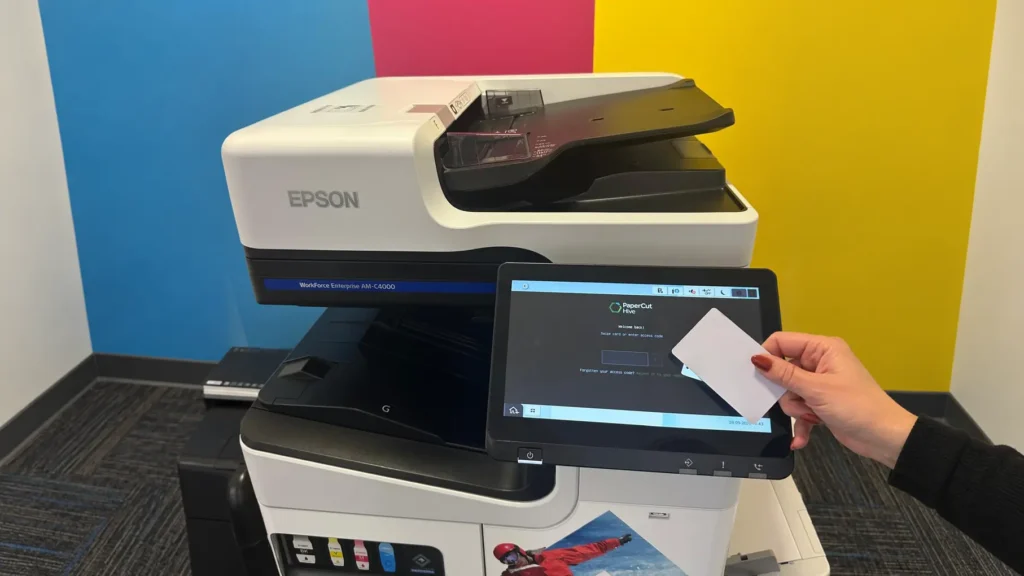
Secure release holds each job until its owner identifies themselves at the device, so nothing sits in a tray. A multifunction device can also keep scanned and copied jobs on its internal drive, so the drive should be wiped before the device leaves your building. Our guide to secure printing for finance and legal firms covers those controls in more detail.
How does managed print cut downtime and admin?
Remote monitoring does most of the work. Each device reports its toner levels and faults to the provider, so supplies arrive before they run out and many faults are caught before anyone notices. Insight publishes 99% device uptime, and its Kent service centre fixes about a quarter of faults remotely, with no engineer visit.
When a visit is needed, our field engineers are employed by us rather than subcontracted, and across all customers our average response time is 2.22 hours. That is an average, not a guarantee, and it is the figure worth asking any provider for.
The admin saving is quieter: one agreement, one invoice and one number to call, and nobody watching a stock cupboard. Quocirca's 2025 managed print study found 89% of IT decision makers see managed print as important to their digital transformation plans, with scanning the service they most want from a provider, since a scanned document rarely needs printing again.
What are the environmental benefits of print management?
The environmental benefits of print management come from printing fewer pages, using less energy per page and offsetting the paper you still use. Printing fewer pages comes first, because each page not printed also saves its toner and energy.
The non-profit in our case study printed 14% fewer pages within a year, and we put the carbon saved at the equivalent of 166 trees. At Sep 2026, PrintReleaf had offset 133,129,146 standard pages for our customers since Apr 2024, planting 15,976 trees in certified reforestation projects.
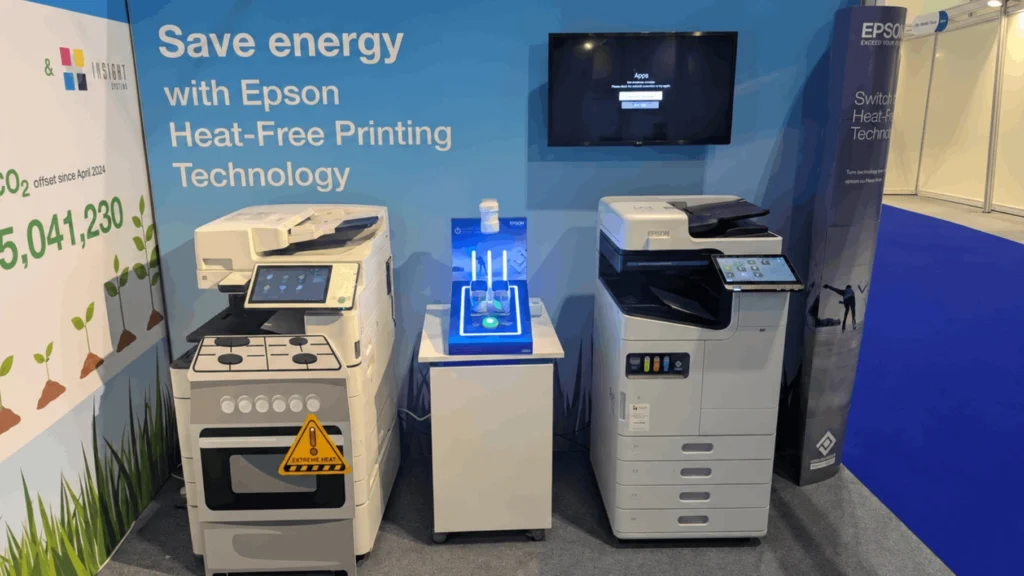
Device choice matters too. Epson reports that its Heat-Free printers use up to 83% less energy than a comparable laser printer, and our heat-free against laser comparison sets out the figures. In Quocirca's 2025 study, environmental impact fell to sixth place among print challenges, behind cost and security, so the environmental gain usually follows the cost work.
| Benefit | The figure | Source |
|---|---|---|
| Lower print costs | Up to 40% off print-related costs | Insight Systems |
| Less waste | 14% fewer pages within 12 months | Insight Systems case study |
| Fewer security incidents | 67% had a print-related data loss last year | Quocirca, 2026 |
| Less downtime | 99% device uptime | Insight Systems |
| Fewer engineer visits | About a quarter of faults fixed remotely | Insight Systems |
| Engineer response | 2.22 hours on average | Insight Systems |
| Reforestation | 15,976 trees planted since Apr 2024 | PrintReleaf, via Insight Systems |
What decides whether you see the benefits?
The provider and the setup matter more than the model. In Quocirca's 2025 study, only 42% of organisations were very satisfied with their MPS provider, down from 48% in 2024, and 42% were open to changing provider at the end of their contract. Cost was the main reason to switch, cited by 47%.
So check a few things before you sign. Ask for an audit first, so the saving is measured rather than assumed, and ask what reporting you will see by user, team and device. Ask who employs the engineers, and for the response figure as an average. Check whether the provider supplies several brands or one, and read the exit terms before you sign, not at renewal. Schools and public bodies buying through a framework should also check the provider is on it.
We hold ourselves to the same list. We have been independent since 2003, supply six manufacturers' ranges, sit on the CPC, Procurement Services and NEPA 3 frameworks, hold ISO 9001, 14001 and 27001, and were named Best International MPS Provider at the 2025 MPSA Leadership Awards.
Is managed print worth it for your organisation?
The benefits of managed print services show most where there are several devices, a mix of brands, or nobody who owns the print budget, and the controls work the same way for one office as for forty. The deciding figure is your own: a free print audit replaces the up-to-40% ceiling with your real number. If the answer is software rather than new hardware, the report says so. Our overview of the full managed print service shows how the parts fit together.
Frequently asked questions
Print management is the software layer: it shows where printing is wasted, sets rules such as mono and double-sided defaults, and holds jobs until the owner releases them at the device. Managed print services are the whole arrangement around it: devices, toner, servicing, monitoring and software on one agreement. Our contracts include secure print management software, and the benefits of print management are a main reason to take one.
Usually, yes. A good provider audits what you run first, because replacing working machines is not automatically the right answer. Often the fix is print management software and a proper service contract rather than new hardware. Where an older device costs more to run than to replace, the audit shows that too.
No. Automatic toner, remote fault monitoring, mono and double-sided defaults and one invoice work on three devices as well as on three hundred, and our audit and savings estimate start at one to five devices. Quocirca's managed print study covered businesses of 250 staff or more, so treat its figures as context rather than a forecast for a small office.
Usually straightforward. A new provider should read what you are tied into, tell you where you stand and handle the changeover. Any cost of leaving early should be clear before you commit, not afterwards. In Quocirca's 2025 study, 42% of organisations were open to switching at the end of their contract.
The free audit replaces the up-to-40% figure with your real one: what each device prints, what it costs and where the waste sits. No obligation, and the report is yours to keep.
Request a Free Print Audit