Print is one of the few office costs nobody examines until something breaks. Then it matters a great deal: who answers the phone, how far away they are, and whether the person who turns up actually works for the company you signed with.
If you are comparing managed print services in London, Essex and Kent, the shortlist will mix national providers, local dealers and lead generation sites that simply pass your details on. So it helps to be clear about what the service is. Managed print services bring every device, its toner, its servicing, the software that controls who prints what and the support behind all of it into one monthly cost, with usage reported so you can see where the money goes.
This guide covers what a contract includes, who attends when a device fails, how the three areas buy it, and what it looked like for one Kent law firm. It is written from how we run print management ourselves, so where a figure is ours it says so.
Key takeaways
- Managed print services put devices, toner, servicing, software and support into one monthly cost.
- Our engineers, helpdesk and workshop staff are our own employees, not subcontractors.
- Our field engineers work from the Wrotham workshop in Kent and cover all three areas.
- Our average service response is 2.22 hours and our fleets hold 99% device uptime.
- Schools and public bodies can appoint us through CPC or Procurement Services with no tender.
What do managed print services include?
A managed print contract covers the devices themselves, the toner that feeds them, the servicing that keeps them running, the software that decides who can print what, and the reporting that shows where the cost sits. That means one supplier, one monthly figure and no separate invoices for cartridges or engineer visits.
The hardware comes first, and getting it wrong is expensive for years. We are independent across Ricoh, Kyocera, Konica Minolta, Toshiba, Brother and Epson, so the recommendation follows your volumes rather than whichever manufacturer we happen to be tied to. A free print audit maps every device, what it costs and where output is wasted, which is the step that stops an office paying for capacity it never uses.
Consumables and faults come next, where the daily aggravation lives. Toner arrives before it runs out rather than after somebody notices an empty tray, and faults are caught remotely before anyone reports them. Nobody on your team becomes the unofficial printer person, chases a cartridge order or sits on hold to report the same jam twice.
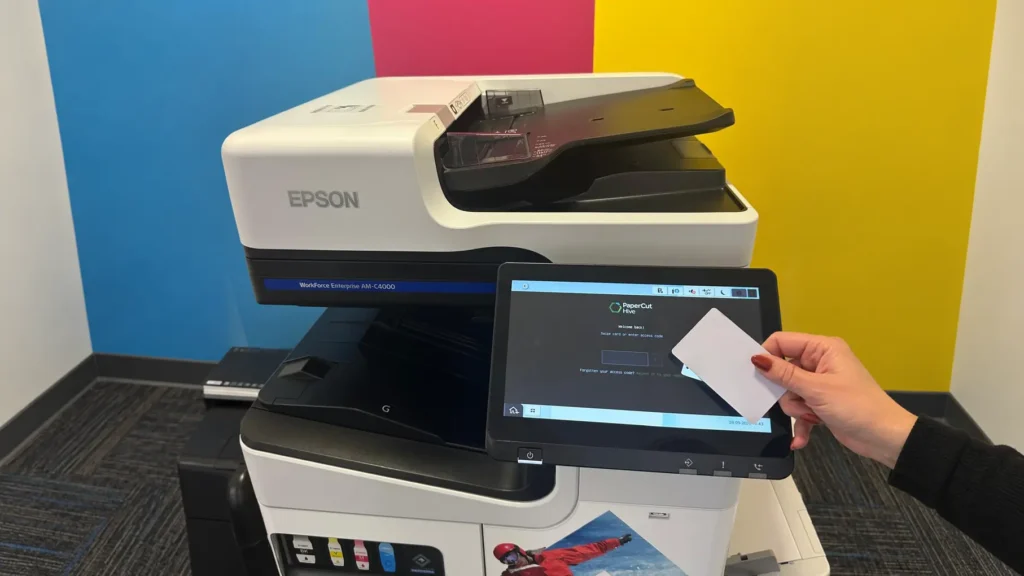
Then there is the software, which is the part that moves the monthly figure. Rules decide who can print in colour and what defaults to mono and double sided, and on a typical page mono costs a tenth of what colour costs. We deploy PaperCut MF alongside PaperCut Hive, Tungsten Printix, DocuWare and Ricoh Smart Integration, and which one suits you comes out of the audit rather than a preference of ours. Secure release holds a document on the device until the person who sent it is standing there, a feature set out in PaperCut's own documentation. It also cuts out the pages printed twice because the first copy went missing from a tray.
Who turns up when a device stops?
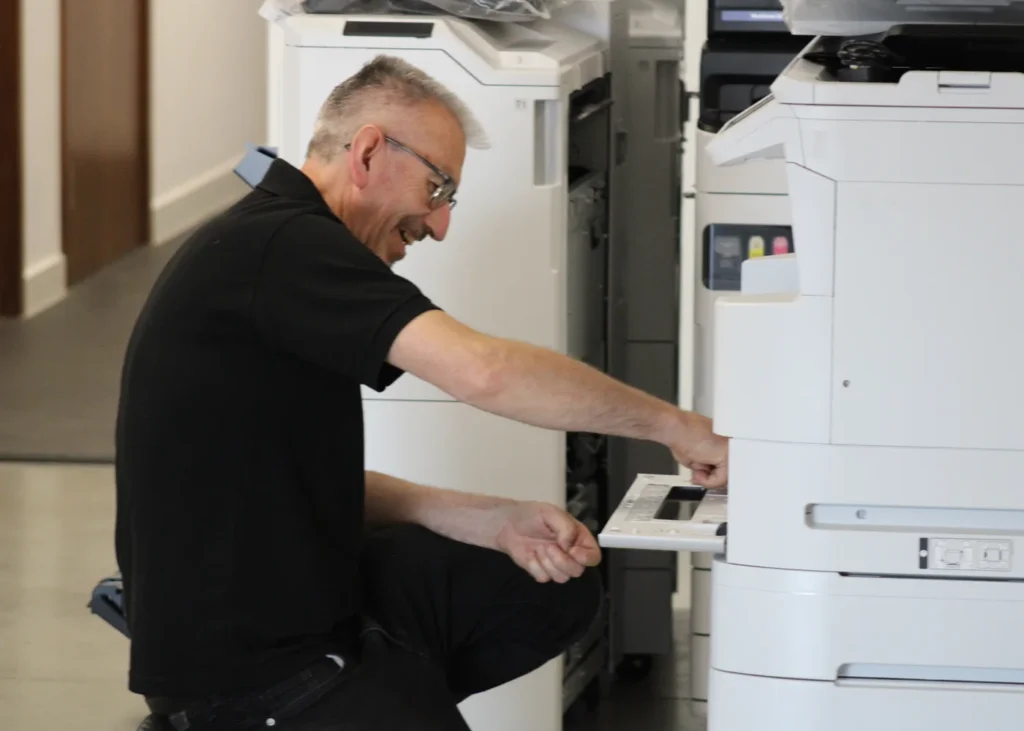
Our own engineers do. They work from the workshop at our head office in Wrotham, Kent, and cover London, Essex and Kent from there. Our average service response is 2.22 hours and the fleets we manage hold 99% device uptime. We publish the average rather than a promise, because the average is the part we can actually measure.
That distinction matters more than it sounds. On a national contract the engineer who arrives usually works for a regional subcontractor you had no part in choosing, and the company named on your agreement is managing a supply chain rather than a machine. It can work perfectly well. It also means that when something goes wrong twice, the conversation runs through two companies instead of one.
Our engineers, helpdesk and workshop staff are on our own payroll rather than subcontracted, and the whole team of more than 30 specialists is listed by name on our team page. One workshop means one set of standards, one parts store and one person accountable for a device from the day it goes in. We have worked this way since 2003, hold ISO 9001, 14001 and 27001, and were named Best International MPS Provider in 2025. We bought a second building on the same estate in July 2026, which is how one base keeps up as more customers come on.
None of that removes the geography, so here is exactly where we are.
| Office | Address | What it is | Service cover |
|---|---|---|---|
| London | 3rd Floor, 86-90 Paul Street, London EC2A 4NE | Regional office for meetings and sales | Our own engineers, from the Wrotham workshop |
| Essex | Mount Farm, Tawney Common, Epping, Essex CM16 7PX | Regional office for meetings and sales | Our own engineers, from the Wrotham workshop |
| Kent | Insight House, Nepicar Park, London Road, Wrotham, Kent TN15 7AF | Head office, with the workshop, stores and engineering team | Our own engineers, based on site |
Read the last column again. There are three addresses and one service base, and the London and Essex offices are where we meet people and where sales sits, the engineering happens in Kent, and post and deliveries go to Wrotham.
We would rather say that plainly than imply a depot in every county. Wrotham sits where the M20 meets the M25, which is what makes one base workable across all three areas. One team covers a solicitor in the City, a warehouse in Essex and a school in Maidstone without handing any of them to a franchise. London alone held 538,000 businesses in March 2025, according to the Office for National Statistics, close to a fifth of the UK total. Plenty of providers claim the postcode, and fewer will tell you who employs the engineer.
How London, Essex and Kent organisations buy it
There are two routes. A business buys directly, usually after an audit and a quote. A school, academy trust, local authority or NHS body can instead appoint a supplier through a public sector framework, where the pricing is already competed and the compliance settled before anyone picks up the phone.
We sit on Lot 1 of the Crescent Purchasing Consortium framework, which the Department for Education recommends and which lets a school appoint us directly with no tender to run, write up and defend. The Department publishes its guidance on approved frameworks for schools. For most buyers the tender is the biggest single cost of buying anything, so removing it is worth more than a discount.
We also hold Lots 1 and 3 on the Procurement Services framework, formerly K.C.S, covering multifunctional devices and heat-free inkjet printers. The reference a buyer needs is Y26009. For health, we are a supplier on NHS Shared Business Services and on NOE CPC. A Kent academy trust and an NHS trust in south London reach the same team by two different compliant routes, and that usually decides how quickly a print project can start.
What it looked like for a Kent law firm
Martin Tolhurst Solicitors is a Kent firm of more than 160 people with offices across the county. It came to us with a dated laser fleet that broke down often and worked against its environmental commitments. We won the tender, then audited every office before recommending anything.
The fleet moved to Heat-Free devices, which have no fuser to hold at temperature, and we added PaperCut for secure release, user permissions and print tracking. A law firm has a sharper reason than most to care whether a document waits in an output tray, and the ICO's guide to data security treats an uncollected page as the same class of problem as an unlocked file.
Since implementation the firm has saved over £35,000 on print through PaperCut. Switching to heat-free technology identified potential savings of up to £120,682 across the term, along with up to 1,373 kWh of electricity, up to 379.34 kg of CO2 and up to 147 fewer ink cartridges. Those are the figures as the case study reports them, each one a ceiling rather than a flat result. Our case study from 2025 sets out how each of those was measured.
The firm's own words on the work, from the case study: "Insight Systems not only provided the latest Heat-Free printing technology but also took the time to work with us directly, office by office, to create a solution that delivers real impact. Their local presence, hands-on service, and shared commitment to sustainability made them the perfect partner." That is Martin Tolhurst Solicitors, quoted as published.
Is a local managed print provider right for your office?
Not always, and it is worth being straight about that. An organisation with sites in Glasgow, Cardiff and Norwich is better served by a national contract, because no single workshop in Kent covers that well.
A local independent provider suits a different organisation. It is one based in London, Essex or Kent that wants to know who is coming when a machine stops, wants advice across six manufacturers rather than one, and wants a compliant route if it is a school or a public body. It suits an office that has grown past the point where somebody's goodwill holds the printing together, and one that would rather replace ageing devices through printer leasing than find the capital. If that sounds like your office, a free print audit gives you the real numbers first, and the findings are yours whatever you decide.
Frequently asked questions
The devices, the toner, the servicing and parts, the software that controls and reports on printing, and the support behind all of it, brought into one monthly cost. There are no separate invoices for cartridges or engineer visits. What varies between providers is the service level, whether the software is included, and who employs the engineer who attends.
Yes. Our head office in Wrotham holds the workshop, the parts store and the engineering team, and our field engineers cover London, Essex and Kent from there. The London and Essex offices handle meetings and sales rather than service. Wrotham sits at the junction of the M20 and the M25, which makes a single service base practical across the three areas.
Our average service response is 2.22 hours, and we quote the measured average rather than a commitment because the average is what we can stand behind. Enquiries get a reply within one working day, often the same day. Faults are often caught remotely before anyone reports them, which is how the fleets we manage hold 99% uptime.
Usually, if the office prints most days and nobody has counted what that costs. Print management typically takes up to 40% off print-related costs, and a small fleet hides waste as well as a large one: a colour device doing mono work, a machine past its best, or pages printed twice. The audit is free, so you can answer it with your own numbers.
Yes, and it is normally the fastest route. We are an approved supplier on Lot 1 of the Crescent Purchasing Consortium framework, which the Department for Education recommends, and we hold Lots 1 and 3 on the Procurement Services framework, formerly K.C.S. For health, we are a supplier on NHS Shared Business Services and NOE CPC. Each removes the need to run a tender.
We have three offices across London, Essex and Kent, and every engineer is on our own payroll. Tell us where you are and what you print, and a free audit shows what the right service level costs.
Request a Free Print Audit